Responsible sourcing
From our earliest days, Aker BioMarine recognized that a sustainable and transparent supply chain is foundational. We source 100% of our krill through Aker QRILL Company (AQC), the world's leading krill harvesting company and our sister company, that grew directly out of our former harvesting operations. This shared origin gives us unique insight into how our krill is harvested and a common foundation of responsible practices built over more than two decades.
Mid-water harvesting
AQC uses a patented modern mid-water harvesting technique designed to minimize environmental impact and maximize traceability and catch accuracy. Scientific studies estimate bycatch at just 0.1–0.3%, among the lowest of any fishery globally.
Observers on all vessels
Every AQC vessel carries an independent scientific observer, ensuring compliance with CCAMLR management rules and providing verified catch and effort data reported in near-real time.
Open science and data sharing
AQC vessels are regularly made available for research to support up-to-date ecosystem knowledge. All vessel data is shared openly with scientists and NGOs through krillscience.com.
We know where every batch of krill comes from
Many consumers demand full transparency regarding the origin of their product choices, particularly when the products come from our oceans. Aker BioMarine recognized early on the need to offer our customers the precise harvesting location for every krill oil batch.
Our krill supplier ensures full traceability, enabling us to pinpoint the exact harvesting location of each batch, made possible thanks to the sophisticated GPS system on board AQC's fishing vessels. This gives us unique insight into their operations and allows us to deliver on the promise of full transparency of every batch of krill to our customers.
Trace your Superba krill
Enter a batch code to see the precise harvesting location, vessel, and catch date for that shipment.
Trace your krillProtecting customers and the environment
Traceability is needed to ensure food safety, offer products that are more responsibly produced, and build consumer trust. Thanks to our krill supplier's transparency, we follow our products' entire production life cycle, providing Aker BioMarine with a high level of quality assurance from ocean to product.
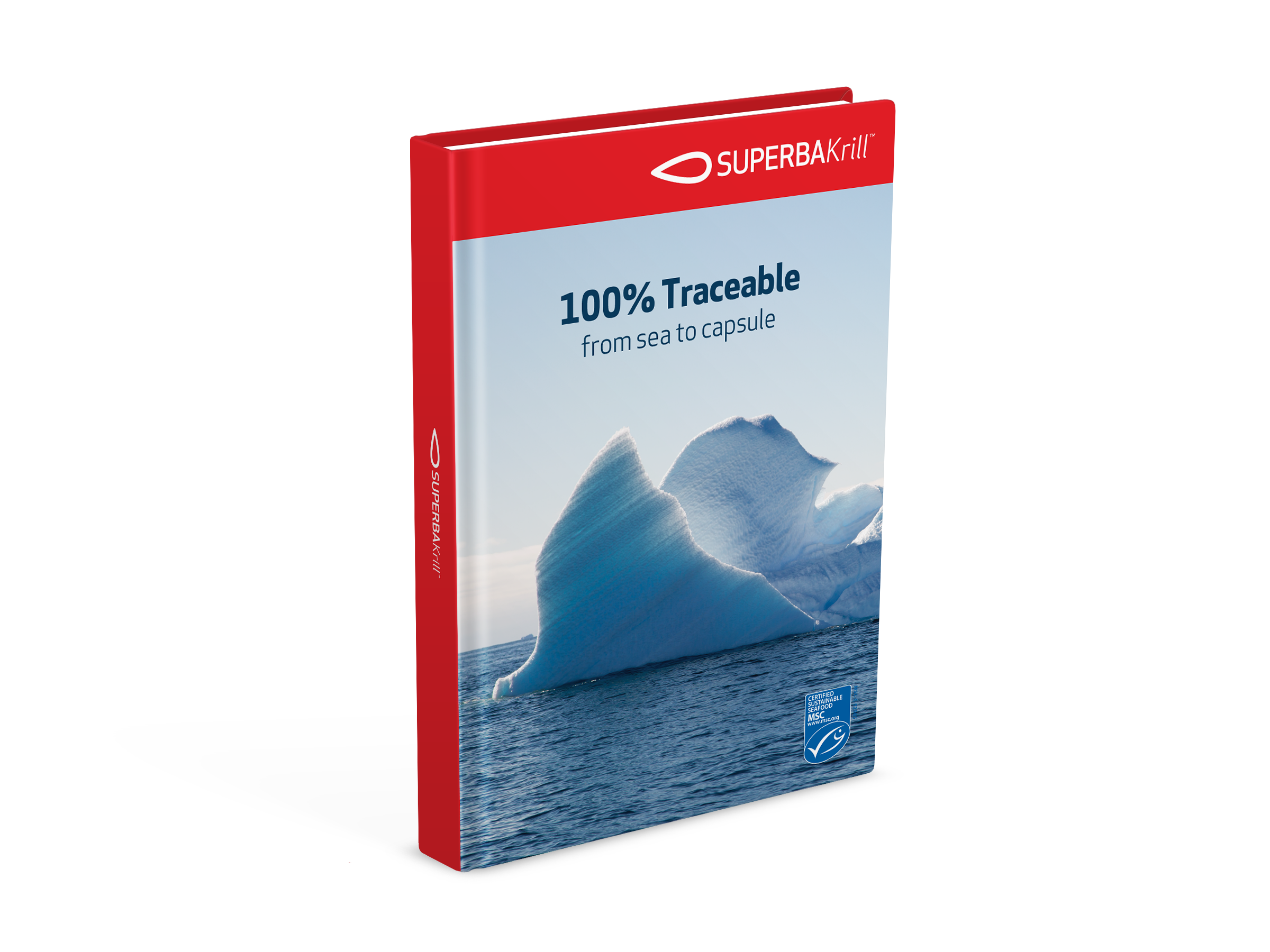
In our brochure you can read more about:
- Where krill is harvested
- Who certifies our traceability
- A traceability tool you can integrate on your website to engage consumers
Independently verified
Independent certifications reinforce the credibility of our sustainability claims and ensure that our products are sourced from a fishery that meets the highest standards.
Marine Stewardship Council (MSC)
MSC is an international non-profit organization that recognizes and rewards efforts to protect oceans and safeguard seafood supplies for the future. AQC holds the MSC certification for the Antarctic krill fishery, and has maintained MSC certification with consistently high scores for over a decade. Aker BioMarine maintains full chain-of-custody certification, ensuring that our krill products can be traced back to the certified fishery.
Sustainable Fisheries Partnership (SFP)
SFP is a global nonprofit working to promote sustainability and transparency in seafood supply chains. For six consecutive years, the Antarctic krill fishery received an "A" rating from SFP for biomass health, the only reduction fishery globally to achieve this rating.
Antarctic krill classified as sustainably fished by the UN Food and Agriculture Organization
In its 2025 Review of the State of World Marine Fishery Resources report, covering more than 2,500 stocks UN FAO's first assessed Antarctic fish stocks, including krill, and classified 100% as fished within biologically sustainable levels. Its 2026 report confirmed the result again, and describes the Antarctic areas as ‘a global benchmark for precautionary, ecosystem-based fisheries management’.
"All assessed stocks in the Antarctic Area are considered sustainably fished. This success can be attributed to robust management practices, comprehensive catch reporting and effective international cooperation."
FAO, Review of the State of World Marine Fishery Resources, 2025 (Technical Paper 721)
Rules governing the Antarctic krill fishery
Aker BioMarine sources Antarctic krill solely from a fishery governed by the Commission for the Conservation of Antarctic Marine Living Resources, an intergovernmental body of 27 member states re sponsible for managing marine resources in the Southern Ocean.
CCAMLR applies an ecosystem-based management approach, meaning the health of the entire Antarctic ecosystem guides all decisions. Its Scientific Committee reviews population and ecosystem data annually to ensure inform management decisions. The result is a highly precautionary and strictly regulated Antarctic krill fishery.
Less than 1% harvested
CCAMLR applies highly precautionary catch limits designed to protect the Antarctic ecosystem. Total annual harvesting accounts for less than 1% of the estimated Antarctic krill species, which is estimated at approximately 68 million tonnes.
Real-time monitoring and mandatory oversight
All catch data is reported at five-day intervals. All vessels are required to carry observers. AQC employs observers across all vessels and shares data openly through krillscience.com.
Science-led ecosystem management
CCAMLR’s Scientific Committee reviews the latest science and data annually, which informs all management decisions. The fishery is managed using an ecosystem-based approach designed to protect the entire Antarctic ecosystem and maintain healthy krill populations.